

Fear is not your enemy, it's a memory
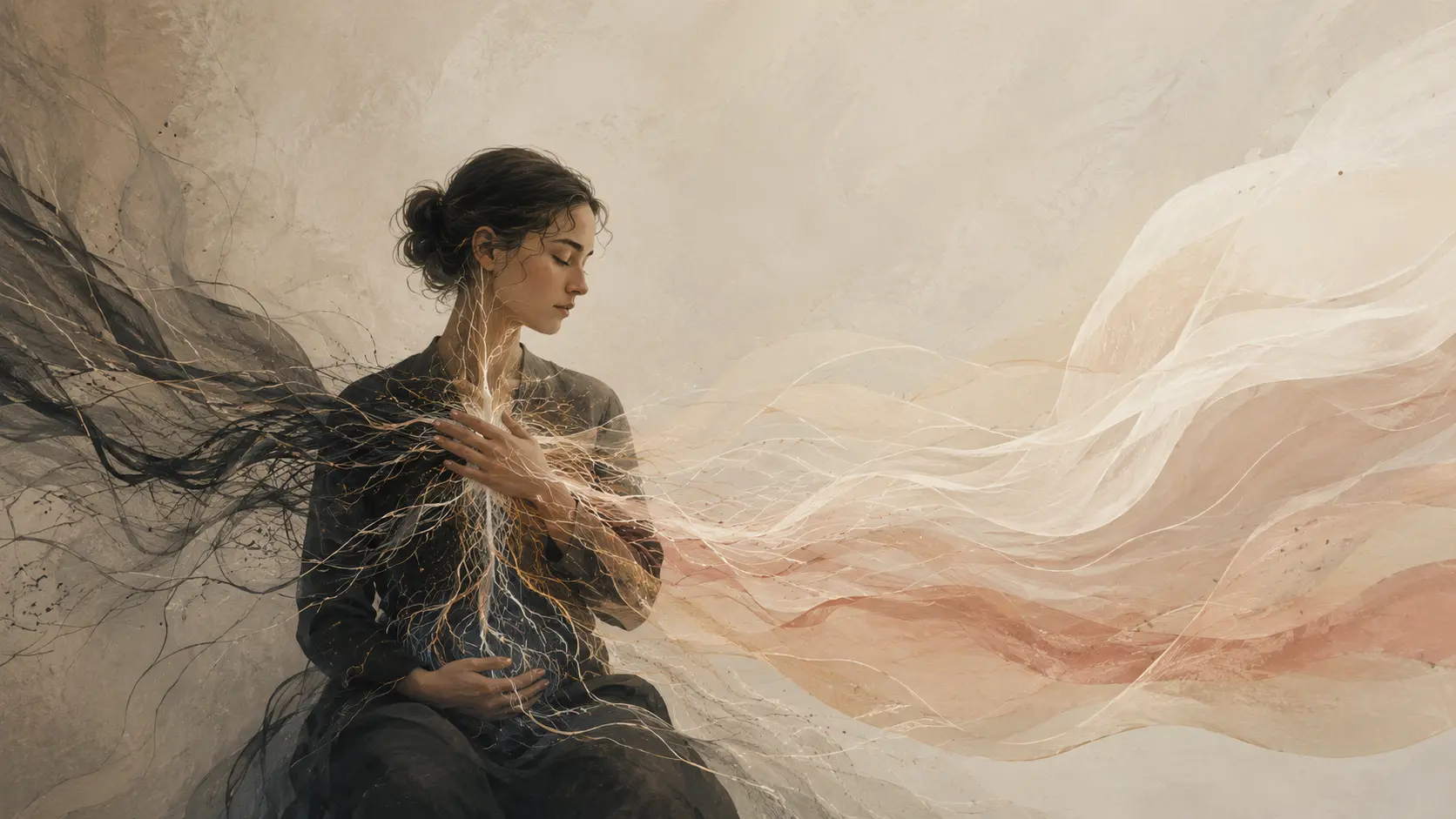
Most of us have spent our lives treating fear as a problem to solve — something to push through, talk ourselves out of, or quietly be ashamed of. We take it as a sign that something is wrong with us: that we are not brave enough, not ready enough, not enough.
But fear is not a flaw in your character. And in most moments, it is not a response to what is actually happening in front of you.Fear is a memory. More than that — it is a way of being.
A way of being we never chose
Fear is not only a feeling that visits and leaves. For most people it is the ground they stand on without knowing it. Around that ground, very early in life, an identity gets built. We construct a whole self around a nervous system that learned the world is not safe — and then we call that self "me."
This is the part almost no one is told: most of humanity lives through the filter of fear without ever realizing it. We believe we are seeing clearly, responding reasonably, being realistic. We are not. We are contracted. And because we have never known anything else, the contraction feels like reality itself.
Where does it begin? Earlier than memory. The first programming starts before birth — in the womb, the body is already absorbing a single question: is this world safe? A mother's own sense of safety, or lack of it, marks the body of the child she carries. Then, in our earliest years, we learn how to be by watching how the people around us meet life. We have no logic yet, no way to reason. We have only instinct, and a body that absorbs everything it is exposed to.
This is why fear is so irrational. You cannot find its source in anything happening now, because its source was laid down before you could think. It was coded into the deep unconscious — inherited through the dynamics of a family, passed down a bloodline as a way of surviving.
Why you cannot think your way out
When something frightens you now — a conversation, a risk, a moment of being seen — the intensity you feel is not about the present alone. Something older opens underneath it. The body does not file that earlier pain away as the past; it keeps it close, ready, just beneath the surface. So when life touches the edge of an old wound, the body responds as if the original danger were happening right now. The heart races. The chest tightens. The story arrives fully formed: this is not safe.
It feels like a reaction to the present. It is a memory wearing the clothes of the present.This is why you cannot think your way out of fear. You can know, with complete clarity, that you are safe — that the email is not a threat, that the room is not dangerous — and still feel your whole system brace. Insight does not reach the place the fear lives. The fear is not in your thoughts. It is in the body.
Working with fear is like calming a frightened animal
Because fear lives below logic, you cannot reason with it. Trying to argue yourself out of fear is like trying to convince a terrified animal that it is safe. It does not understand words. It reads only energy, safety, presence.
So we work with fear the way we would approach a wounded, frightened animal. Not with arguments — with gentleness, with patience, with space. We let that part of us feel, slowly, that it is safe in our presence. And this cannot be rushed. Everyone has their own tempo here, and honoring that tempo is the whole thing. There is no version of this that happens on schedule. There is only the steady offering of safety, again and again, until the frightened part begins to trust.
What that part needs is not to be fixed. It needs to be met — to have its wound accepted, and to finally receive the care it never got. The more we learn to give that to ourselves, the more the body softens. And as the body softens, we become steadier, more trustworthy to ourselves, more able to create.
First, recognize the grip
You cannot soften something you cannot feel. So the first movement is simply to recognize that you are in contraction at all — to learn the particular signature of your own fear in your body.
Where does it grip? The throat, the chest, the stomach, the jaw? What happens to your posture, your breath, your attention? Each of us has a signature — a familiar shape the body takes when the old memory opens. Learning to recognize it is not a small thing. It is the difference between being the fear and seeing it. The moment you notice the grip, you are no longer entirely inside it.
From there, the work is to teach the body to release — to loosen its hold on the story that keeps the grip in place.